
Once you start looking into indoor air in Central Florida, the add-ons pile up quickly: high-MERV filters, a UV light for the AC, sanitizing sprays, duct coatings and more. Some are simple and inexpensive. Others are sold hard with big promises. This guide sorts them using what the U.S. EPA and other neutral sources actually say, with a focus on what matters in a humid climate like Orlando's.
One ground rule first: the EPA says duct cleaning "has never been shown to actually prevent health problems," and it is equally cautious about many air-cleaning gadgets. Nothing below is a health recommendation. If you have health concerns, ask your doctor.
Why humidity changes the conversation
In Orlando, the AC is a dehumidifier as much as a cooler. NOAA's 1991–2020 normals show summer dew points averaging above 70°F from June through September and roughly 3,452 cooling degree days a year. The EPA recommends keeping indoor humidity "below 60 percent (ideally between 30 and 50 percent)" and notes that "the presence of condensation or high relative humidity is an important indicator of the potential for mold growth" in ducts.
That means the add-ons worth the most attention are often the boring ones: a filter that fits, a clean coil and drain pan, a drain line that flows, and ducts that don't leak humid attic air. Gadgets come after those basics.
MERV filters: which rating is right for a Florida home?
MERV (Minimum Efficiency Reporting Value) rates how well a filter captures particles. Higher numbers catch smaller particles. The question homeowners usually ask, "what's the best MERV filter for Florida?", doesn't have one answer, because the right filter depends on what your system can handle.
The EPA's practical guidance, given in its advice on reducing smoke indoors, is to use a filter rated MERV 13 or "as high a rating as your system fan and filter slot can accommodate." That second half matters. A denser filter that your blower can't push air through, or one that doesn't seal in the slot, can do more harm than good.
- Check the fit. Use the exact size printed on the current filter frame. Gaps around the edges let air bypass the filter entirely.
- Ask about your system. If you want to move up to MERV 13, ask an AC contractor whether your blower and return can handle it.
- Change it on schedule. A loaded filter restricts airflow. A system that runs most of the year, as many Orlando systems do, moves more air through its filter.
- Keep it dry. A filter that gets damp, for example from a closet air handler with drainage problems, can hold odor. Fix the moisture source.
Good news: changing a filter is homeowner work. DBPR's licensing handout lists "Change an A/C filter" as something that does not need a license.
Is a UV light for HVAC worth it?
UV lights, sometimes called UVGI (ultraviolet germicidal irradiation), are mounted inside the air handler, usually aimed at the coil or into the airstream. They are a popular add-on, and the "uv light for ac" search term gets steady interest in Orlando. Here's what the EPA says in its page "Does ultraviolet (UV) radiation (UV lamps) kill mold?":
- UVGI cleaners "may destroy indoor biological pollutants such as viruses, bacteria, and some molds."
- But "typical UVGI cleaners used in homes have limited effectiveness in killing bacteria and molds."
- And "dead mold spores can still produce allergic reactions."
So a UV lamp is not a fix for a moisture problem. If the drain pan holds water, the coil is caked with dust or a duct is sweating in the attic, a light won't change the cause. The EPA's broader point applies here: "If the conditions causing the mold growth in the first place are not corrected, mold growth will recur."
If you're still considering one, ask:
- Where exactly would it be mounted, and what is it meant to do: keep the coil surface cleaner, or treat moving air?
- How often does the lamp need replacing, and what does a replacement cost?
- Does the unit produce ozone? The EPA describes ozone as "a highly reactive gas that is regulated in the outside air as a lung irritant."
- Will mounting it require opening the air handler? In Florida, that's licensed AC contractor work.
We don't publish a price for UV light installation because we haven't found a neutral, reliable source for one. Ask for a written quote.
Coil and drain pan cleaning: the less glamorous upgrade
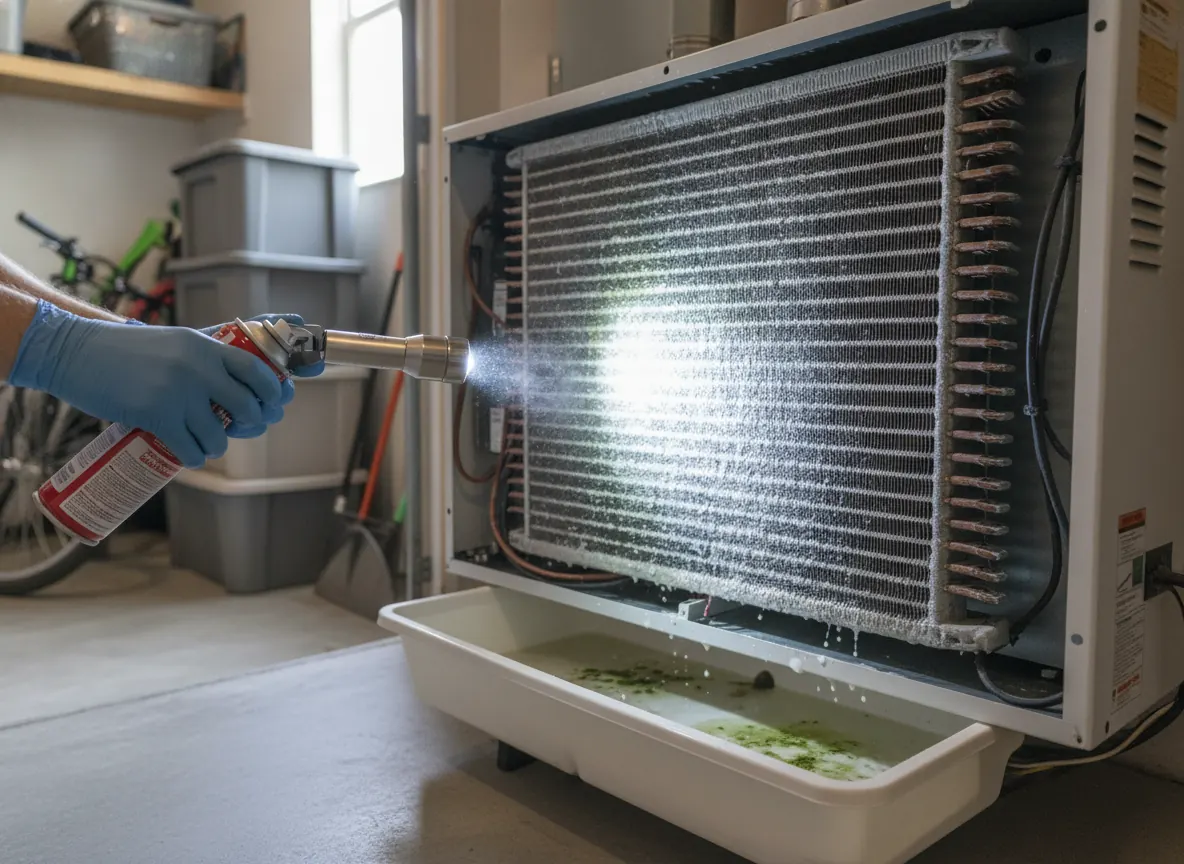
The EPA notes that "some research also suggests that cleaning dirty cooling coils, fans and heat exchangers can improve the efficiency" of a system, while "little evidence exists to indicate that simply cleaning the duct system will increase your system's efficiency." It also advises: "Keep air conditioning drip pans clean and the drain lines unobstructed and flowing properly."
In a humid climate, a clean coil and a free-flowing drain address the wet surfaces where odor and growth tend to start. This is licensed work in Florida because it involves opening the air handler. Learn more on our AC coil and air handler cleaning and condensate drain line pages.
Sanitizers, fogging and duct coatings: proceed with caution
Sanitizing or "fogging" is often offered as an add-on to duct cleaning. Cost guides list it at about $100–$250 when it isn't included (an estimate, not a quote). Before saying yes, read the EPA's cautions:
- For biocides in ducts, "research has not demonstrated their effectiveness in duct cleaning or their potential adverse health effects."
- "No chemical biocides are currently registered by EPA for use in internally-insulated air duct systems," and none are registered "for use on fiber glass duct board or fiber glass lined ducts." Many Florida homes have exactly those materials.
- If you permit one, the provider should "show you the biocide label" and apply it "only to un-insulated areas of the duct system after proper cleaning."
Duct coatings, or encapsulants, are another upsell. The EPA reports that NADCA, NAIMA and SMACNA "do not currently recommend the routine use of sealants to encapsulate contaminants in any type of duct," and that sealants "should never be used on wet duct liner, to cover actively growing mold, or to cover debris in the ducts."
Duct sealing: different from coating, and often worth a look
Don't confuse coatings with sealing leaks. The EPA says: "Sealing duct air leaks can help save energy on heating and cooling bills." In Florida, leaks matter twice, because a leaky return can pull hot, humid attic air into the system. Florida Solar Energy Center testing of new central Florida homes found "significant leaks" in the ductwork "in a majority of homes tested."
If you're an OUC electric customer, OUC offers a duct repair and replacement rebate of "100% of the cost, up to $100," for ducts sealed with mastic (or mastic with embedded UL-approved tape) on all accessible boots, joints and seams. It covers sealing and repair, not cleaning. Check OUC's current terms before you book. See our duct repair and sealing page.
A sensible order of operations
Fix moisture first
Measure indoor humidity, clear the drain, and address sweating ducts or grilles.
Get the filter right
Correct size, good seal, the highest MERV your system can handle, changed on time.
Clean what's actually dirty
Coil, pan, blower or ducts, based on what a contractor can show you. The EPA says clean ducts only "as needed." See is duct cleaning worth it in Florida?
Consider add-ons last
UV lights, sanitizers and coatings only with clear answers and written terms.
Compare quotes
We connect Orlando-area homeowners with independent local air duct and HVAC companies for free, no-obligation quotes. We don't do the work ourselves and aren't a contractor. Ask any company for its CAC or CMC license number and check it at MyFloridaLicense.com. When you're ready, request a free quote, or review typical prices in the cost guide.