
AC Coil & Air Handler Cleaning in Orlando
We connect Orlando-area homeowners with independent local HVAC companies for free, no-obligation quotes on evaporator coil, blower and air handler cleaning. We don’t do the work ourselves and aren’t a contractor.
Get a Free Quote Call (727) 300-6656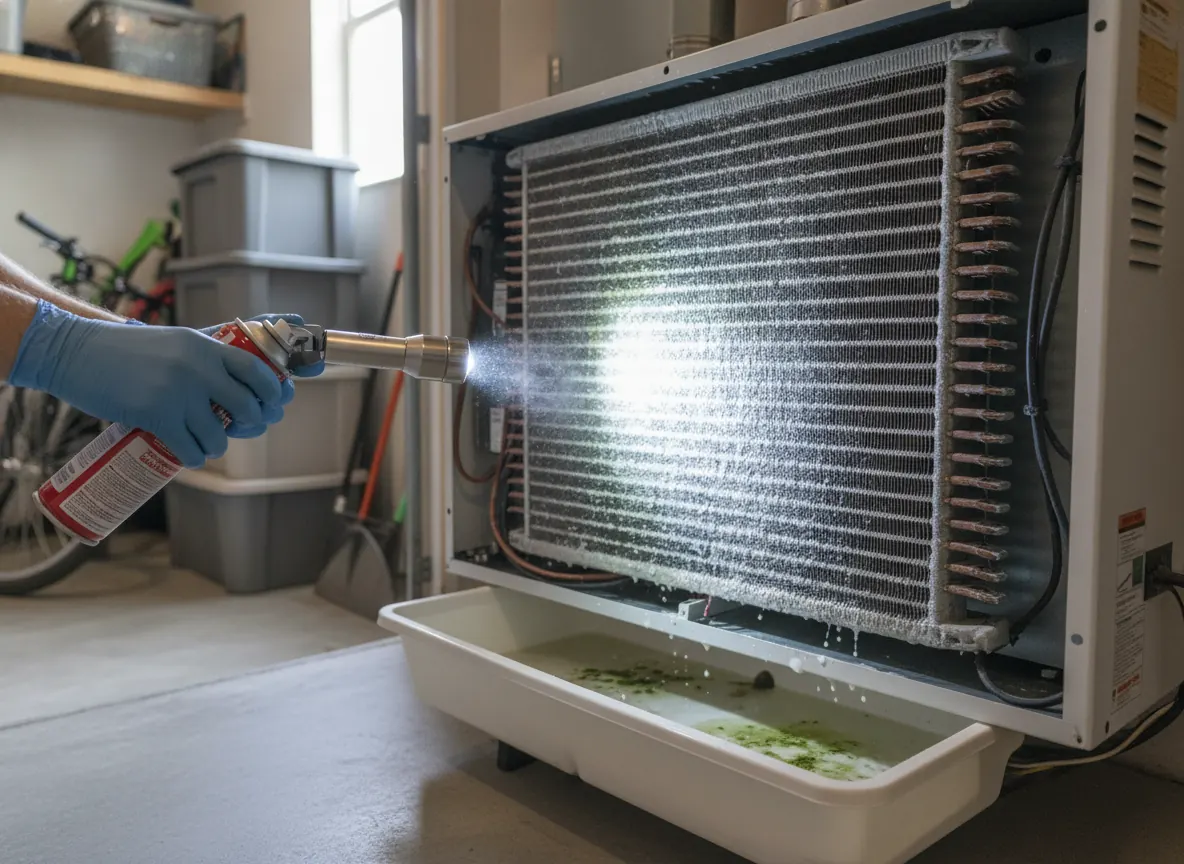
Why the air handler matters more than the vents
The air handler is the indoor half of a central AC system: the cabinet that holds the evaporator coil, the blower fan and the condensate drain pan. In Central Florida it works almost all year. NOAA’s 1991–2020 normals for Orlando International Airport show about 3,452 cooling degree days against roughly 525 heating degree days, with cooling demand in every month — even January — and an average of about 110 days a year at 90 °F or hotter.
EPA’s definition of duct cleaning includes “heating and cooling coils, condensate drain pans (drip pans), fan motor and fan housing, and the air handling unit housing,” and warns that “failure to clean a component of a contaminated system can result in re-contamination of the entire system.” A vent-only cleaning that skips the air handler may leave the main source untouched.
What EPA says about coils and efficiency
EPA draws a careful line. “Some research also suggests that cleaning dirty cooling coils, fans and heat exchangers can improve the efficiency of heating and cooling systems. However, little evidence exists to indicate that simply cleaning the duct system will increase your system’s efficiency.” In other words, if efficiency is your goal, the coil and blower are where the evidence points — not the ducts alone.
Air-handler leaks also matter in Florida. A 2002 Florida Solar Energy Center (FSEC) study of 30 central Florida homes built the year before found the average installed air-handler cabinet let about 6% of system airflow leak in from the garage or attic. That’s one more reason to have the cabinet looked at closely. For leaky ducts and cabinets, see duct repair and sealing.
Drain pans, humidity and moisture: EPA’s guidance
The coil pulls moisture out of the air, and that water collects in a drain pan and leaves through a condensate drain line. EPA’s Brief Guide to Mold, Moisture and Your Home (updated February 2026) gives three simple rules that apply directly:
- “Keep air conditioning drip pans clean and the drain lines unobstructed and flowing properly.”
- “If possible, keep indoor humidity below 60 percent (ideally between 30 and 50 percent) relative humidity.”
- “Condensation can be a sign of high humidity.”
EPA’s duct guide adds that “the presence of condensation or high relative humidity is an important indicator of the potential for mold growth,” and that an oversized air conditioner can cause “poor moisture removal, particularly in areas with high humidity.” Orlando’s summer dew points average above 70 °F from June through September, so moisture control is the heart of air-handler care here. If you’re seeing growth, read mold in AC vents and ducts; for drainage problems, see AC condensate drain lines.
Florida law: this is Class A/B air-conditioning work
Florida’s Class A and Class B air-conditioning contractor definitions, s. 489.105(3)(f) and (g), cover work to “install, maintain, repair” central air-conditioning systems, “and any duct cleaning and equipment sanitizing that requires at least a partial disassembling of the system.” Opening the air handler to clean the coil, blower or drain pan fits that description. Class B is limited to 25 tons of cooling in any one system, which covers essentially all single-family homes. Mechanical contractors have the same duct-cleaning and sanitizing wording in their scope.
In Florida, duct cleaning that involves removing grilles and AC coil work is licensed air-conditioning contractor work — ask for the company’s CAC/CMC license number and check it at MyFloridaLicense.com; a county business tax receipt is not a license. This is general information, not legal advice.
UV lights for the AC: EPA’s “limited effectiveness” finding
Ultraviolet germicidal irradiation (UVGI) lamps are often offered as an add-on to coil cleaning. EPA’s page Does ultraviolet (UV) radiation (UV lamps) kill mold? says UVGI cleaners “may destroy indoor biological pollutants such as viruses, bacteria, and some molds,” but “typical UVGI cleaners used in homes have limited effectiveness in killing bacteria and molds.” It also notes that “dead mold spores can still produce allergic reactions.”
No authoritative published price for a UV light was found, so none is listed here. If a company recommends one, ask what specific problem it targets, and whether fixing humidity, the drain pan or the drain line would solve that problem first. Our post on MERV filters and UV lights in a humid climate goes further.
Questions to ask about coil and air handler cleaning
- What is your CAC or CMC license number? (Verify it at MyFloridaLicense.com.)
- Can you show me the dirty coil, blower or drain pan before you start?
- Which parts will you clean — coil, blower, drain pan, cabinet — and will you put that in writing?
- What products will you use, and can I see the label?
Costs vary with access and condition, and no reliable published price for coil cleaning alone was found — see the cost guide for related ranges. When you’re ready, request free quotes or call Call (727) 300-6656.
Frequently asked questions
Does cleaning the AC coil improve efficiency?
It may. EPA says “some research also suggests that cleaning dirty cooling coils, fans and heat exchangers can improve the efficiency” of a system, while “little evidence exists to indicate that simply cleaning the duct system will increase your system’s efficiency.” Ask the company to show you the dirty coil or blower before agreeing to the work, and get the scope in writing.
Is AC coil cleaning licensed work in Florida?
Generally, yes. Opening the air handler to clean the evaporator coil, blower or drain pan falls within the Class A and Class B air-conditioning contractor scope in s. 489.105(3)(f)–(g), which covers maintaining central AC and equipment sanitizing that requires partial disassembly. Ask for the CAC or CMC number and verify it at MyFloridaLicense.com. This is general information, not legal advice.
Are UV lights for an AC worth it?
EPA is cautious. It says UVGI cleaners may destroy some biological pollutants, but “typical UVGI cleaners used in homes have limited effectiveness in killing bacteria and molds,” and “dead mold spores can still produce allergic reactions.” If a company recommends one, ask what problem it is meant to solve and whether fixing moisture or drainage would address that problem first.
What indoor humidity should I aim for in Orlando?
EPA’s mold guide says, “If possible, keep indoor humidity below 60 percent (ideally between 30 and 50 percent) relative humidity.” It also notes that condensation can be a sign of high humidity. If your home stays clammy, ask an air-conditioning contractor to look at system sizing and moisture removal, since EPA says an oversized unit can remove moisture poorly.
How do I know if my drain pan needs attention?
EPA advises homeowners to “keep air conditioning drip pans clean and the drain lines unobstructed and flowing properly.” Standing water, a musty smell near the indoor unit, or water where it shouldn’t be are reasons to have an air-conditioning contractor take a look. Our condensate drain line page covers the drain side in more detail.
Dusty vents or a musty AC smell? Compare quotes.
Free, no-pressure quotes across Orlando, Kissimmee, Winter Park, Sanford and Central Florida.